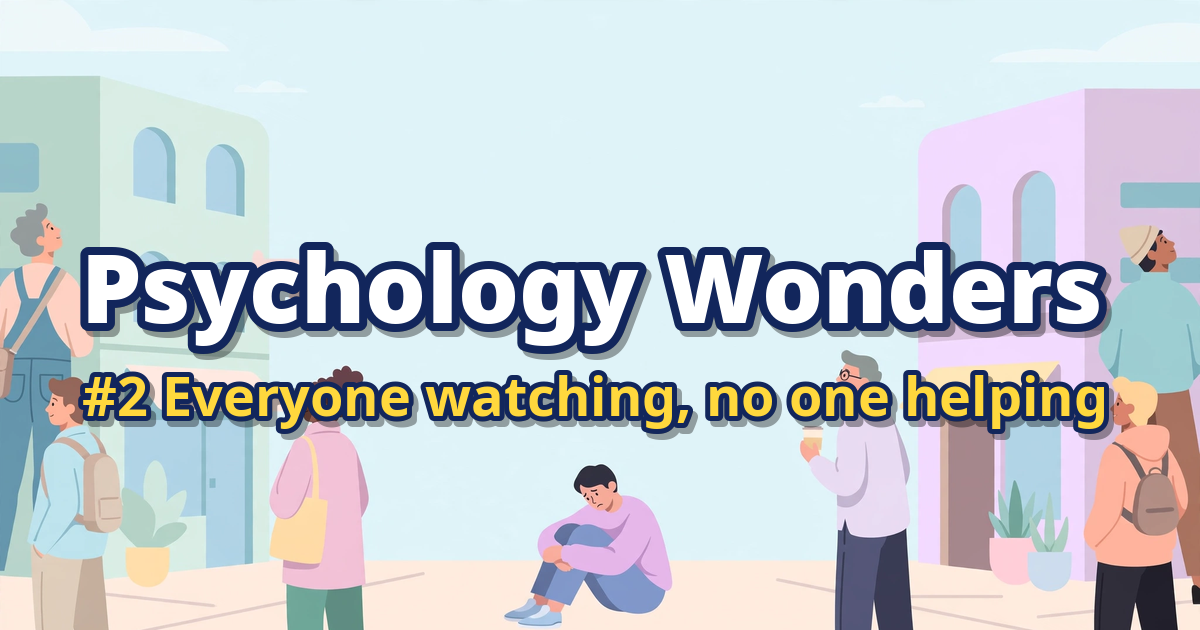
Psychology Wonders #2
The Takeaway
When no one helps, it is not because everyone is cold. Two brakes are at work — “someone else will surely do it” and “everyone else looks perfectly calm” — and the more bystanders there are, the harder it becomes for anyone to move at all.
You have probably seen someone in trouble at a station and walked straight past, thinking, “Someone will stop and say something.” Many of us have. And it turns out this is a phenomenon that has been clearly reproduced in experiments. It is called the bystander effect.
In 1968, psychologists Latané and Darley ran the following experiment. Participants, listening over an intercom, heard another participant appear to suffer a seizure. When people believed they were the only one listening, 85% of them moved to help.
But when people believed four others were listening too, only 31% did.
In another experiment, smoke began drifting into a room — but when the people nearby (actors who had been asked to do nothing) stayed perfectly calm, only 10% went to report it. When a person was alone, 75% went to report it.
There are two mechanisms behind this. The first is the “diffusion of responsibility”: the more people there are, the more the responsibility thins out into “someone else will handle it, even if I don’t.”
The second is that we look at how calm everyone around us seems and conclude, “This must not be a big deal.” Psychologists call this pluralistic ignorance.
The important point is that the people who did not move were not indifferent. Inside, they were panicking. It was not coldness — the situation itself had applied the brakes.
Seen from the other side, there is a trick to asking for help. Do not shout, “Someone, help!” Instead, single out one person: “You, in the blue clothes — please call an ambulance.”
When responsibility has exactly one name attached to it, the brakes come off much more easily.
The silence of a crowd is not the coldness of a crowd. Just knowing that raises the chance that, when it matters, you will be the one who moves.
References
- Darley & Latané, “Bystander intervention in emergencies: Diffusion of responsibility” (Journal of Personality and Social Psychology, 1968)
- Latané & Darley, “Group inhibition of bystander intervention in emergencies” (Journal of Personality and Social Psychology, 1968)
Leave a Reply