Disaster Lessons #1
The Takeaway
The 1977 Tenerife airport disaster forced a fundamental overhaul of the language used between air traffic controllers and pilots — and of the hierarchy inside the cockpit.
Here is what happened, and what changed.
What Happened
On March 27, 1977, Los Rodeos Airport on the Spanish island of Tenerife was wrapped in thick fog. Many aircraft had been diverted there after their destination, Gran Canaria Airport, was temporarily closed.
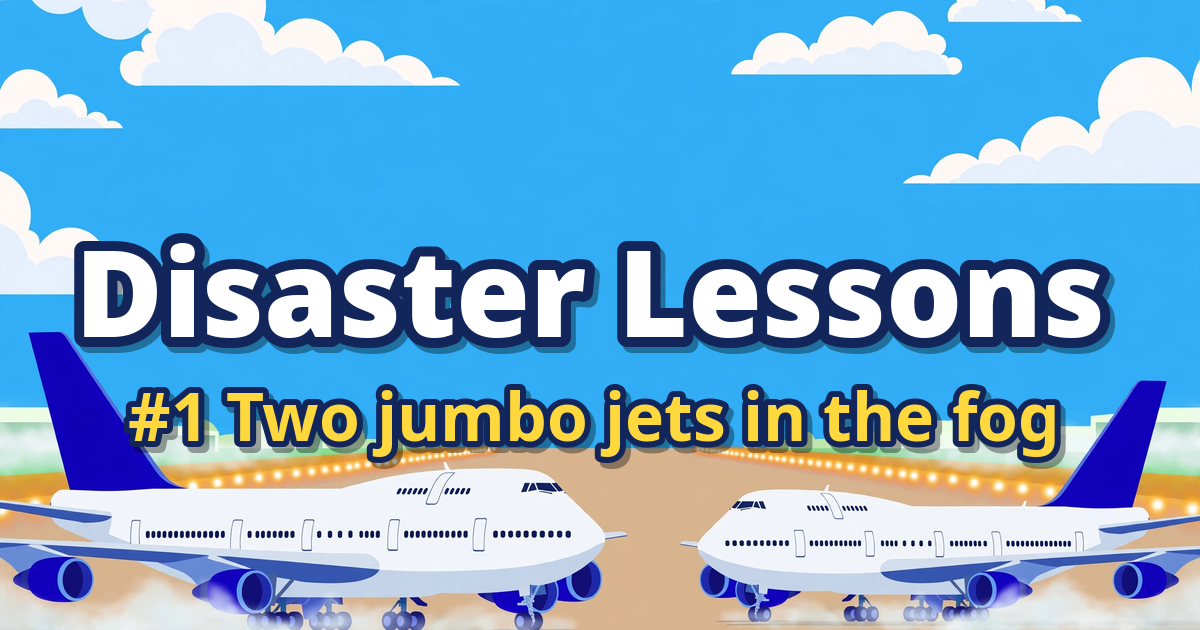
On that runway, two Boeing 747s collided: KLM Flight 4805 and Pan American Flight 1736. Just as the KLM aircraft began its takeoff roll, the Pan Am aircraft was still taxiing on the same runway.
The collision and the fire that followed killed 583 people: all 248 passengers and crew aboard the KLM aircraft, and 335 of the 396 people aboard the Pan Am aircraft. It remains the worst accident in aviation history.
What Went Wrong
The Spanish investigation concluded that the primary cause was this: the captain of the KLM aircraft took off believing he had received clearance to do so. What the controller had actually issued was a route clearance — not permission to take off.
The radio exchange, however, was ambiguous. When the KLM crew reported, “We are now taking off,” the controller replied with a single word: “OK.” That “OK” was taken as the signal that they were cleared.
There was a second wall, inside the cockpit. The captain was one of KLM’s most senior instructor pilots, and it is believed the first officer found it difficult to firmly challenge his judgement.
It is the same kind of mix-up as replying “OK” to a friend’s message about meeting up and then getting the time wrong — except that here, the misunderstanding led, in fog, to a collision with another aircraft that could not be seen.
What Changed
The investigation report strongly recommended standardising radio phraseology. The main changes were these:
- The word “takeoff” is now used only when takeoff clearance is being given or cancelled
- Clearances are no longer acknowledged with ambiguous replies like “OK” or “roger”; instead, the content of the clearance is read back verbatim for confirmation
- In the cockpit, the idea of Crew Resource Management (CRM) — the captain is not absolute, and every crew member is expected to speak up — became a foundation of training
In short, two systems were put in place at the same time: one to eliminate “I thought I said it” and “I thought I heard it,” and one to eliminate the atmosphere in which things are hard to say.
What We Take for Granted Today
Today, exchanges between pilots and controllers are built on the readback of set phrases. That almost mechanical, meticulous radio chatter you can hear on a flight is the lesson of this accident, made routine.
In the cockpit, too, a first officer or flight engineer raising a concern is no longer considered impolite — it is part of the job. Everyone in the crew supports the captain’s decisions together. That is the norm in today’s skies.
A single misunderstood word took 583 lives.
That is why, in the skies today, words are kept short and precise — and anyone can call a stop. That is the everyday practice this accident left behind.
References
- Spanish Civil Aviation Accident Investigation Commission, “Final Report: Collision between B747 KLM and B747 PAN AM, Los Rodeos, Tenerife, Spain, 27/03/1977”
- U.S. Federal Aviation Administration (FAA), “Tenerife Airport Disaster, 1977”
Leave a Reply